Open LoRA · streaming audio + video
Uncensored TaoMate-H3: AI Video That Starts Playing While It Is Still Being Made
Waiting three minutes for a ten-second clip kills the fun of AI video. This streaming LoRA changes the rhythm: instead of rendering the whole clip and then showing it, it builds picture and sound in small chunks and hands you the first playable part after about 17 seconds. Released as an open LoRA by the Alibaba TaoLive AIGC team, the team behind Taobao's livestream AI tools, it sits on top of the open-weight MiniMax H3 model and keeps going for as long as you keep feeding it prompts. That makes it a natural fit for talking hosts, product demos and episodic stories. Here is what it does, where it shines, how to prompt it and what it takes to run.
- 3-step LoRA
- Plays while rendering
- 480p · 768p · 1080p
- Open weights
TaoMate-H3 vs MiniMax H3: from three minutes to seventeen seconds
The headline is speed. MiniMax H3 is a strong open audio-video model, but like most video generators it finishes the entire clip before you can watch a single frame. TaoMate adds a LoRA trained to denoise each chunk in only three steps, then streams the chunks out in order. In the team's own test on eight NVIDIA H20 cards, a ten-second 480×864 clip became watchable in 17.3 seconds instead of 183.3 seconds, and the core diffusion work dropped from almost 170 seconds to under 15.
Memory use barely moved, so the speed-up does not come from a bigger machine. What the team has not published is a side-by-side on image quality or motion range, so treat picture quality as something to judge with your own eyes rather than a proven win.
| Official test (8×H20, 480×864, 10 s) | MiniMax H3 | With the LoRA | Gain |
|---|---|---|---|
| First playable video | 183.3 s | 17.3 s | 10.6× faster |
| First finished chunk | 170.1 s | 6.1 s | 27.7× faster |
| Diffusion (DiT) time | 169.6 s | 14.8 s | 11.45× faster |
| Peak DiT memory | 32.03 GiB | 31.37 GiB | About the same |
Three steps per chunk: streaming audio-video generation in plain words
Picture a printer that hands you each page as soon as it is ready instead of waiting for the whole report. The model cuts the video and its soundtrack into short slices and creates each slice in three denoising passes. Every finished slice is written into a memory cache, and the next slice is generated on top of it, so the story can continue without a fixed end. For a ten-second clip the official notes count 24 generation passes and 8 cache updates.
Keeping a face and voice stable over a long take is the hard part. The research paper behind the project introduces anchor-guided memory: a reference state that locks in what the character looks and sounds like, which reduces colour drift and identity wobble as minutes pass. Picture and sound are produced together, so lips, speech and room tone stay in step rather than being glued on later.
The paper's benchmarks are impressive, with 35 frames per second on three GPUs versus 23 for LiveAvatar on five and 16 for LongLive-2.0 on four, plus the top lip-sync score. Keep in mind those numbers were measured on a 22-billion-parameter generator initialised from LTX-2.3, not on the H3 release, so they show the method's promise rather than this exact model's results. Among open-source options for real-time AI video, it is one of the few that streams sound and picture together.
Digital human hosts, live-style product demos and short dramas
Because it comes from Taobao's livestream team, the obvious stage is the talking presenter. The official first-and-last-frame demo is a 30-second clip of a host seated in a family living room explaining how to organise storage, exactly the kind of segment shopping streams run all day. The project never promises a full live-commerce product, but the ingredients are there: a steady face, a natural voice and output that arrives quickly enough to keep a production schedule moving.
Talking hosts and explainers
One presenter, one room, a script split into short beats. Ideal for how-to clips, home tips and channel intros that need a friendly face on camera.
Product demos and ad drafts
Draft several versions of a 15-second pitch, swap the line or the product angle, and compare them side by side before booking a real shoot.
Short dramas in episodes
Chain five-second beats into a continuous scene. Rain, neon, a whispered line and a reveal, all keeping the same actor from beat to beat.
Vertical-first social video
Native 768×1376 and 1088×1920 portrait sizes drop straight into short-video feeds without cropping. The paper also tested Mandarin and English speech.
Building a one-minute AI video, five seconds at a time
Long AI video is where streaming really pays off. Length is set in five-second blocks, and you can either reuse a single prompt for the whole run or pass a JSON list with one prompt, and optionally one seed, per five-second block. Think of it as a storyboard: block one introduces the host, block two shows the product, block three is the close-up, and the model carries the same person and room through each change. The official examples run 30 seconds, and the paper tests a full minute of 1,441 frames.
Output comes in three sizes: 480p for quick drafts, 768p as the default and 1080p for delivery, each in landscape or portrait. The first-and-last-frame variant runs at a fixed 24 fps in 768×1376 portrait, handy when every shot must start and end on an exact pose.

Prompt templates for talking hosts and serial scenes
The trick to consistent long takes is repetition. Restate the person's look, outfit and setting in every block, give each block only one main action, put spoken lines in quotation marks and describe the sound separately. These starters follow that pattern and work as a first draft for your own scripts.
Talking host · block 1
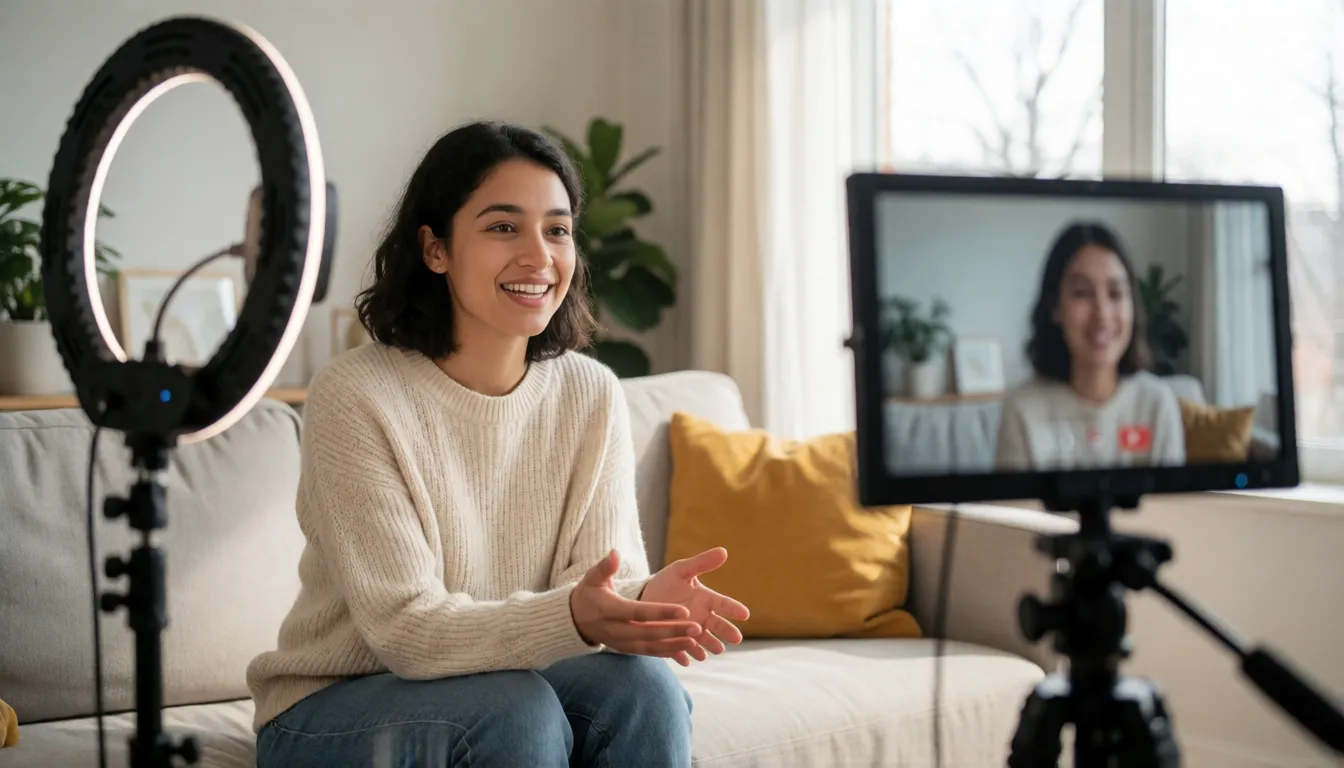
Medium shot, a young woman in a cream sweater sits on a sofa in a bright living room, speaking to camera, explaining how to fold towels into a storage box, natural gestures, warm daylight, steady camera. Audio: clear female voice, soft room tone.
Talking host · block 2 (continuation)
Same woman, same cream sweater, same living room. She lifts the box toward the camera and smiles: "This one fits three towels." Camera slowly pushes in. Audio: same voice, light rustle of fabric.
Short drama beat
Night street in the rain, a man in a black trench coat turns around, close-up, he says in a low voice: "You came after all." Neon reflections on wet asphalt. Audio: steady rain, distant thunder.
Adult swimwear spot (18+, fictional model)
An adult fashion model in her late twenties in a red bikini walks along a sunny beach and talks to camera about this summer's swimwear, relaxed smile, tracking shot. Audio: her voice, waves, gentle breeze.
TaoMate-H3-FL2VA and TaoMate-HD: the growing family
The project moves fast. The first release in September 2026 brought text-to-audio-video streaming to H3. On 15 October 2026 the team added TaoMate-H3-FL2VA, which takes a first frame and a last frame and streams the clip in between, described by the team as, to their knowledge, the first real-time first-and-last-frame audio-video model. That is the version to reach for when a storyboard pins down how each shot begins and ends.
On 3 November 2026 came TaoMate-HD, which builds on the H3 runtime with progressive generation aimed at sharper results; its project page has the details. Reference-based generation (Ref2AV) is listed as coming later, with no date yet.
Running the model from Hugging Face and GitHub
The LoRA itself is small, just a config, an adapter config and one safetensors file (rank 128), published on Hugging Face with a ModelScope mirror. Setup lives in the GitHub repository. The catch is hardware: the only verified setup is eight NVIDIA H20 96 GB cards, and the scripts accept four or eight Hopper-class GPUs.
- 1Prepare Linux with Python 3.10 or 3.11, CUDA 12.8, PyTorch 2.8, vLLM 0.11.1, FlashAttention for Hopper and FFmpeg.
- 2Download the MiniMax H3 base model (model_index.json plus its folders) and the TaoMate LoRA from Hugging Face.
- 3Pick a size (480p, 768p or 1080p) and set --duration to a multiple of 5 seconds.
- 4Pass one --prompt for the whole clip, or --prompt-json with one prompt and optional seed per five-second block.
- 5Run with --gpus 4 or 8 and watch the first chunks play while the rest is still generating.
- GPU requirements: no minimum VRAM is published and there is no official path for RTX 4090 or 5090 cards.
- ComfyUI: no official nodes exist yet, so the command line is the supported route.
- Online demo: two community Spaces on Hugging Face let you try the 3-step model in a browser, and the model page lists a hosted inference provider.
Why creators are watching this release
Open, real-time audio-video generation is rare, and that is what has people paying attention. Within about two months the GitHub repository passed 800 stars, the Hugging Face page collected more than 130 likes and the community spun up two public demo Spaces. The excitement centres on seeing a clip begin almost instantly and on long takes that keep the same face. The main thing holding most people back is plain to see in the requirements: a multi-GPU data-centre setup, with no official consumer-card or ComfyUI path yet.
Uncensored TaoMate-H3: what open weights mean for adult creators
There is no separate uncensored edition of TaoMate-H3, and none is needed in the usual sense: both the LoRA and the H3 base are open weights, the official pages describe no content filter or safety classifier, and a local run never passes through a cloud moderation service. For adult creators that means the rules are set by the model's own licence and your own setup. If you lack an eight-GPU rig, Spicy AI offers a similar relaxed-filter image-to-video tool online for adult, fictional characters.
Upload a still of your original adult character and bring it to life with sound, no GPU needed.
Open image to videoUncensored Alternative Video Generator
Start from one photo of an original adult character, describe the movement and the line they should say, and get a short talking clip in your browser.
Start generatingSelf-hosting the LoRA vs generating online on Spicy AI
Running it yourself gives you real-time streaming and full control; the online route trades that for zero setup.
| Local deployment (official weights) | Spicy AI online | |
|---|---|---|
| Content filters | You configure your own setup | Relaxed filters for adult content (18+) |
| Open weights | Yes (LoRA + H3 base) | Not needed, runs in the browser |
| Model actually used | TaoMate LoRA on MiniMax H3 | A hosted image-to-video model |
| Price to start | Four to eight Hopper GPUs | Free tier available |
FAQ
What is TaoMate-H3?
A 3-step LoRA and streaming runtime built on MiniMax H3 by Alibaba's TaoLive AIGC team. It generates audio and video together in chunks, so playback starts while the rest is still rendering.
How much faster is it than MiniMax H3?
In the official test on eight H20 GPUs at 480×864 for 10 seconds, the first playable video arrived after 17.3 seconds versus 183.3 seconds, and diffusion time was 11.45 times shorter.
Can it run on an RTX 4090 or 5090?
Not officially. Only Hopper GPUs are supported, the verified setup is eight H20 96 GB cards, four or eight GPUs can be used, and no minimum VRAM has been published.
Does it support first-and-last-frame video?
The main release is text to audio-video. First-and-last-frame streaming comes from the FL2VA add-on, released on 15 October 2026. Reference-based generation has not shipped yet.
How long can the videos be?
Length grows in five-second steps and can keep going. Official samples run 30 seconds, and the paper evaluates one-minute clips of 1,441 frames.
Is there a ComfyUI node?
Not from the team so far. The supported way to run it is the command-line scripts in the GitHub repository.
Is there an uncensored version?
No dedicated one exists. The weights are open and the official pages describe no built-in filter, so a local run is governed by the H3 community licence rather than cloud moderation.