Open-weight AI chat · Reflection AI
Beam 1.0: Reflection AI's 501B Open Model for Code, Agents and Long Chats
Beam 1.0 is the first big open-weight model from Reflection AI, a US lab that wants to give developers an American answer to the strong open models coming out of China. It is a sparse mixture-of-experts (MoE) model with 501 billion parameters in total, yet only about 23 billion of them switch on for each token, so it thinks like a giant while running closer to the cost of a mid-size model. It reads up to 1 million tokens at once, and anyone can download the weights from Hugging Face.
- 501B MoE
- 1M context
- Open weights

Uncensored Alternative AI Chat Generator
Want long, unfiltered roleplay and adult fiction without renting a GPU server? Open the uncensored chat and start writing in seconds.
Open uncensored chat →An American open model built to take on the MoE giants
Reflection AI announced Beam on October 5, 2026 with an early-access waitlist, then published the full checkpoint, Beam-1.0-501B-A23B, on Hugging Face in mid-October. The name spells out the design: 501B total parameters, A23B for roughly 23B active. Inside are 52 layers (3 dense and 49 MoE) with 256 experts, gated grouped-query attention mixed with sliding-window attention, and a 152k-token vocabulary. It handles text only, was built mainly for English, and has a knowledge cutoff of June 30, 2026. According to Forklog, the base model was pre-trained on 23.8 trillion tokens in under four weeks, followed by four more weeks of reinforcement learning across about 1.3 billion virtual environments. The model card also claims it needs around three times fewer reasoning tokens than rivals of similar quality, which means faster and cheaper answers.
Where it shines: everyday jobs for Reflection's flagship
Reflection AI tuned the model above all for software work and long, multi-step tasks, but a huge context window and fluent writing make it useful far beyond coding. These are the scenarios where the model earns its hype:
- Coding partner: fixing GitHub issues, refactoring legacy files and writing tests. Coding benchmarks are where the vendor posts its strongest numbers.
- Agents and tool use: command-line and DevOps chores, browsing and MCP tool calls inside long agent loops.
- Giant-document Q&A: drop in a contract bundle, a codebase or a whole book and ask questions across 1 million tokens of context.
- Summaries and research notes: turning reports, transcripts and papers into short, quotable findings.
- Creative writing and roleplay: multi-turn stories, character voices and plot twists for adult fiction, kept to fictional adult characters.
- Private deployments: companies that want a strong assistant inside their own servers so data never leaves the building.

Copy-ready prompt templates for code, research and stories
The model follows plain instructions well, so the best prompts state a role, a task and an output shape. Swap the parts in braces and paste any of these into a chat window:
- Long-document summary: You are a precise analyst. Summarize the following document into 5 key findings, each with a supporting quote: {document}
- Code refactor: Act as a senior Python engineer. Refactor this code for readability and explain each change in one short line: {code}
- Bug hunt: Here is an error log and the related file. Find the most likely root cause, propose a minimal fix and list one test that proves it: {log} {file}
- Roleplay (adult fictional characters only): You are {name}, a {personality} character in a {genre} story. Stay in character, write vivid third-person narration, and end each reply with a choice for me.
- Creative writing: Write a 600-word noir short story about {topic}, told in first person, with a twist ending.
- Agent plan: Break this goal into numbered steps, name the tool you would use at each step, and stop to ask me before anything irreversible: {goal}
Tip: the model card evaluates with temperature 0.7 and top_p 0.99, a sensible starting point for both coding and storytelling.
Hugging Face downloads: BF16, FP8 and NVFP4 builds
All official files live under the reflection organization on Hugging Face. The main repository, reflection/Beam-1.0-501B-A23B, holds the full-precision BF16 checkpoint. A separate FP8 repository was produced with the llm-compressor tool from the vLLM team, and Reflection also publishes NVFP4 results for a 4-bit build aimed at newer NVIDIA hardware. Reflection says it does not forbid fine-tuning, quantizing, merging or distilling the weights, and the Hugging Face model tree already lists community fine-tunes and quantized builds.
| Version | Where | Best for |
|---|---|---|
| BF16 (original) | reflection/Beam-1.0-501B-A23B | Maximum quality, fine-tuning and making your own quants |
| FP8 | reflection/Beam-1.0-501B-A23B-FP8 | Serving on data-center GPUs with about half the weight memory |
| NVFP4 | Listed by Reflection alongside BF16 and FP8 results | Newest NVIDIA cards with 4-bit support |
| Community quants (GGUF and others) | Model tree on the Hugging Face page | Big-memory Macs and mixed CPU + GPU setups; check each card |
Running it locally: realistic VRAM and hardware math
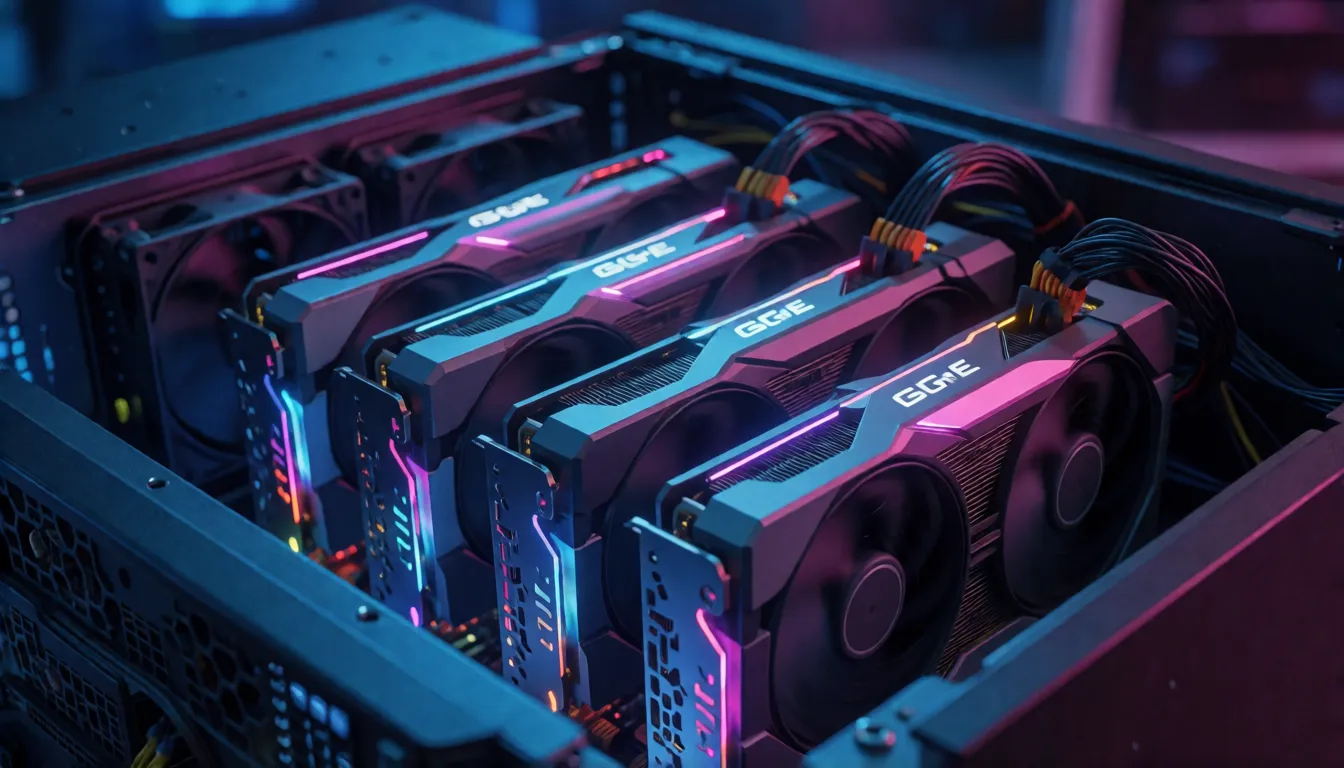
The model card does not publish official GPU requirements, so here is honest back-of-envelope math. Every parameter takes 2 bytes in BF16, which means about 1 TB of weights before you count the cache for that long context. FP8 roughly halves this to around 500 GB, and 4-bit builds land near a quarter. Even though only 23B parameters are active per token, all 501B must sit in memory, so this is multi-GPU server territory rather than a gaming PC.
- Data-center route: load the FP8 checkpoint on a multi-GPU node; its compressed-tensors format comes from the vLLM toolchain.
- Mac and workstation route: a community GGUF on a machine with several hundred gigabytes of unified memory or RAM; expect slow output.
- Ollama, LM Studio and llama.cpp: the card says quantized versions can run in these apps, but confirm that the build you pick names support for this architecture.
- No hardware at all: Baseten appears as an inference provider on the model page, and the model is also listed on HuggingChat.
Beam 1.0 vs DeepSeek, Qwen and GLM
Beam enters a field dominated by Chinese open MoE families. Reflection's own claims, as reported by Forklog, are bold but specific: comparable to GLM-5.2 in programming and agent tasks, approaching Qwen3.8-Max, and matching GLM-5.2 on advanced reasoning with three to four times less compute at inference. The company also admits that Kimi K3 is still ahead in absolute capability. No independent lab had published its own scores at the time of writing, so treat these as claims.
| Beam 1.0 | DeepSeek, Qwen and GLM families | |
|---|---|---|
| Origin | Reflection AI, United States | Chinese labs |
| Design | MoE, 501B total and about 23B active | Mostly MoE flagships plus smaller dense models |
| Context | 1M tokens | Varies by release |
| Open weights | Yes | Yes for most releases |
| Community uncensored versions | None found yet | Many abliterated and uncensored fine-tunes |
Benchmark scores and early reactions
Reflection published a long table of results for the BF16, FP8 and NVFP4 builds, and the quantized versions barely lose ground. Every number below is vendor-reported at temperature 0.7, not an independent test, but together they show where Reflection is aiming: real software work, math and science, and tool-using agents.
| Benchmark | BF16 score |
|---|---|
| SWE-bench Verified | 81.6 |
| Terminal Bench v2.1 | 80.1 |
| LiveCodeBench | 88.3 |
| AIME 2026 | 97.7 |
| GPQA Diamond | 90.6 |
| MCP Atlas | 80.8 |
| IFBench | 79.6 |
Early coverage framed the launch as an American open model built to compete with Chinese products. The strongest praise centres on coding and efficiency; the main caveat repeated by observers is that third-party evaluations had not yet appeared.
Is there an uncensored Beam 1.0?
Not yet. The official chat model is safety-tuned: on Reflection's own harmful-request test it refuses or redirects about 89% of the time, and pretraining data was filtered for harmful content. Because the weights are open, the community could build an abliterated or uncensored fine-tune later, but no such version was found on Hugging Face when this page was written. People who want fewer refusals today usually turn to abliterated Qwen, GLM or DeepSeek fine-tunes, or to an online uncensored chat for adult roleplay and fiction.
- Search the Hugging Face model tree for abliterated or uncensored tags before downloading any derivative.
- Read each derivative's card: community builds are not reviewed by Reflection AI.
- Keep roleplay to fictional adults (18+) and never involve real people.
Self-hosting the open weights vs chatting online on Spicy AI
| Local deployment (official weights) | Spicy AI online | |
|---|---|---|
| Content filters | Safety-tuned official model | No content filters |
| Open weights | Yes | Not needed — runs in the browser |
| Model | Open weights (BF16, FP8 or NVFP4) | Similar uncensored chat model, hosted online |
| Price to start | Free download, your own multi-GPU server | Free tier available |
FAQ
Which lab made the Beam model?
Reflection AI, a US company. It announced Beam on October 5, 2026 and released the downloadable weights on Hugging Face in October 2026.
How big is Beam 1.0?
It has 501 billion parameters in total, but as a mixture-of-experts model it activates only about 23 billion per token, spread over 52 layers and 256 experts.
How long a context can it read?
The model card lists a 1 million token context window, enough for large codebases, long contracts or a full novel in one prompt.
Can I run Reflection's Beam model on my own computer?
Not on a typical PC. The full model needs roughly 1 TB of memory in BF16 and around half that in FP8. Community quantized builds lower the bar, but you still need hundreds of gigabytes of memory.
Is there an uncensored or abliterated version?
None was found at the time of writing. The official model is safety-tuned. Abliterated Qwen, GLM or DeepSeek fine-tunes, or an online uncensored chat, are the usual alternatives.
How good is it?
Reflection reports 81.6 on SWE-bench Verified and 97.7 on AIME 2026, among other scores. These are vendor-reported results; independent evaluations had not been published yet.